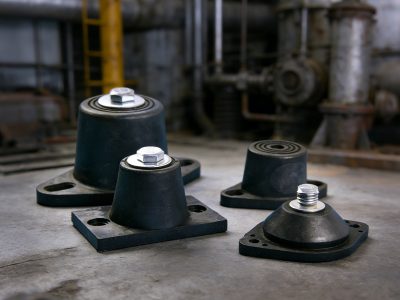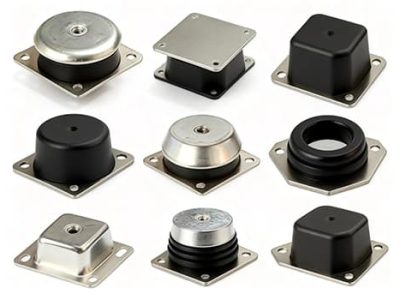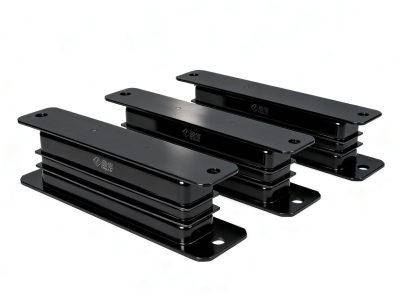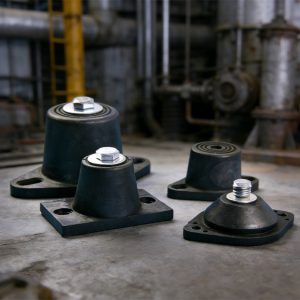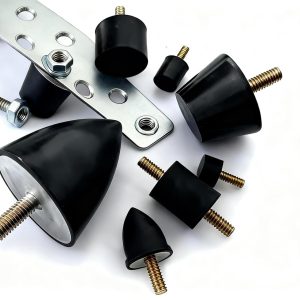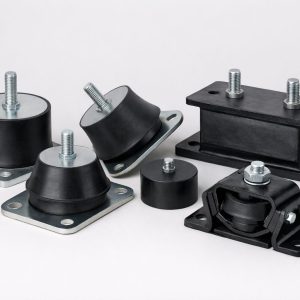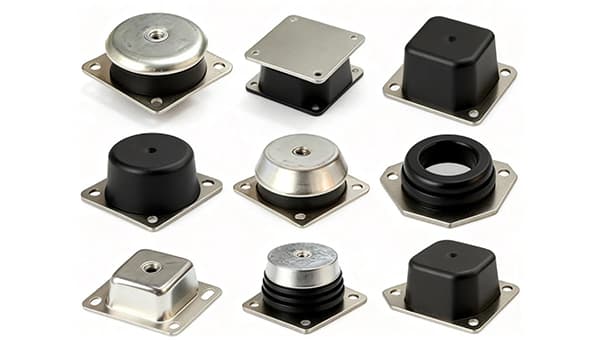
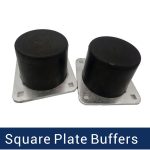
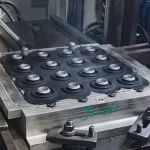
Custom Rubber Isolator A04
- Structural Design Based on Load and Frequency
- Rubber Material Selection for Performance Stability
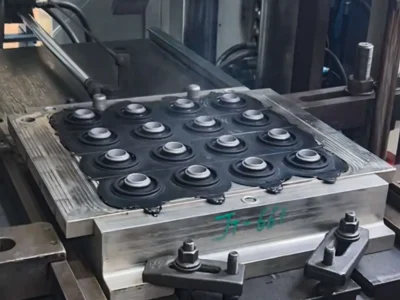
- Precision Mold Design and Tooling
- Advanced Rubber-to-Metal Bonding Technology
- Controlled Vulcanization Process
- Application-Specific Customization
- Quality Testing and Performance Validation
Custom Rubber Isolator can not only be installed, but also truly protect your equipment from fatigue failure and noise pollution. We will optimize your vibration control plan.
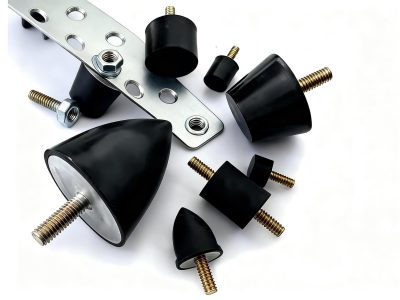
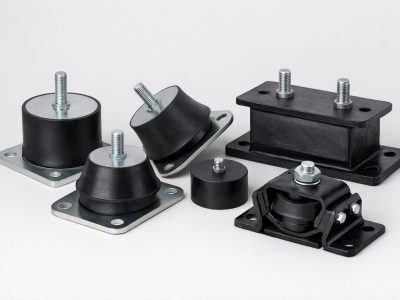
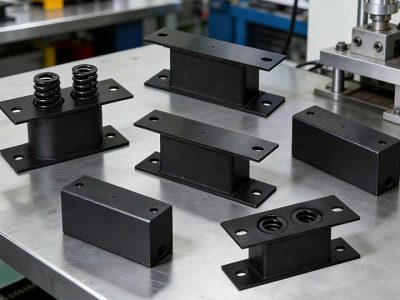
A good Custom Rubber Isolator is not a simple molded part—it is a carefully engineered component where geometry, rubber formulation, and bonding technology work together to achieve optimal vibration attenuation under specific working conditions.
Contact us for Vibration Control Solutions
Who we do for custom rubber isolator manufacturing
1. Engineering Analysis & Vibration Modeling for Custom Rubber Isolator Design
Before physical production, manufacturers conduct a deep dive into the application’s physics.
Natural Frequency Calculation: To avoid resonance, the isolator’s natural frequency must be significantly lower than the equipment’s disturbing frequency .
Load Profiling: Calculating static loads (weight) and dynamic loads (shocks/impulses) to determine the required Spring Rate.
FEA (Finite Element Analysis): Using software like ANSYS or Abaqus to simulate stress distribution and identify potential failure points in the rubber geometry.
2. Custom Compound Formulation Solution for Custom Rubber Isolator
The “secret sauce” of a professional manufacturer lies in the material science. Depending on the environment, they select and customize elastomers:
Natural Rubber (NR): Superior resilience and tear resistance; best for heavy machinery.
EPDM: Excellent for outdoor applications due to UV and ozone resistance.
Silicone: Ideal for extreme temperatures (-50°C to +230°C) and medical environments.
Neoprene (CR): Good balance of oil and weather resistance.
3. Advanced Manufacturing Processes
Professional manufacturers utilize three primary methods depending on the complexity and volume:
| Process | Best For | Technical Benefit |
| Compression Molding | Large, simple parts | Cost-effective for low-to-medium volumes. |
| Transfer Molding | Complex shapes | Better dimensional tolerances than compression. |
| Injection Molding | High-volume production | Fast cycle times and high precision for intricate designs. |
4. Rubber-to-Metal Bonding (The Critical Step)
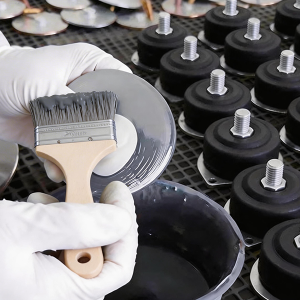
Many isolators require a metal plate or stud for mounting. This involves a rigorous chemical bonding process:
Surface Preparation: Metal inserts are degreased and sandblasted to create a high-energy surface.
Adhesive Application: A two-stage primer and adhesive system is applied.
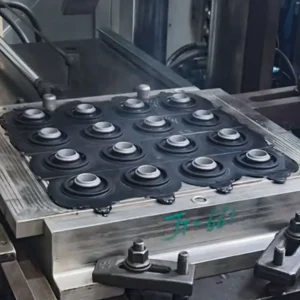
Vulcanization Bonding: The rubber is cured directly onto the metal under heat and pressure, creating a bond stronger than the rubber itself.
5. Quality Assurance and Performance Testing
A professional manufacturer provides a Certificate of Analysis (COA) through rigorous testing:
Static & Dynamic Stiffness Testing: Verifying the part deflects correctly under load.
Durometer Testing: Confirming the Shore A hardness matches the specification.
Environmental Aging: Accelerated aging in ovens or ozone chambers to simulate 10+ years of service.
Damping Ratio Analysis: Measuring the energy dissipation of the material.
Technical Solutions & Engineering Excellence for Custom Rubber Isolators
As a premier ODM/OEM, we provide more than just rubber components; we deliver high-fidelity engineering solutions. Our process integrates advanced simulation and rigorous material science to solve complex dynamic challenges.
1. 3D Finite Element Analysis (FEA) & Simulation
Presenting simulation data significantly enhances technical credibility. We conduct industry-specific simulations to ensure long-term reliability:
Industrial Machinery: We simulate Stress Distribution Maps under vertical loads. This demonstrates how the isolator’s geometry avoids stress concentration during 15% compression, thereby maximizing fatigue life.
Aerospace & Defense: We perform Random Vibration Frequency Response simulations. We prove our isolators achieve over -20d Battenuation in high-frequency environments up to 2000Hz.
Medical Equipment: We conduct Creep Prediction analysis. Our data ensures that under a constant 5-year load, height variation is maintained within pm0.1mm, preserving the precision of optical sensors.
2. Laboratory Material Performance Report (Industry Benchmarks)
The following table outlines our leading material standards across the four core sectors:
| Test Parameter | Test Standard | Our Leading Metric | Strategic Value |
| Dynamic-to-Static Ratio (Kd/Ks) | ASTM D5992 | ≤1.25 | Prevents the material from hardening under high-frequency vibration. |
| Compression Set | ASTM D395 | < 15% (70℃x22h) | Ensures no structural collapse under long-term equipment weight. |
| Ozone Resistance (EPDM) | ASTM D1149 | 100pphm, 168h No Cracks | Meets the 25-year maintenance-free requirement for wind/solar. |
| Low Outgassing (TML) | ASTM E595 | < 1.0% | Aerospace grade; prevents contamination of optical lenses. |
| Biocompatibility | USP Class VI | Passed | Safe for surgical robotics and sensitive medical environments. |
3. Sector-Specific Solutions
Industrial Machinery
Challenge: Balancing high load-bearing with rapid energy dissipation.
Solution: High-damping natural rubber (NR) compounds with non-linear stiffness profiles for CNC and hydraulic systems.
Aerospace
Challenge: Performance stability under vacuum and extreme thermal cycling.
Solution: Fluorosilicone (FVMQ) bonding with titanium alloy substrates, meeting NASA outgassing standards.
Renewable Energy
Challenge: 20+ years of exposure to salt spray and UV radiation.
Solution: Tri-axial isotropic isolators made of high-concentration EPDM for wind turbine nacelles.
Medical Equipment
Challenge: Ultra-quiet operation and chemical resistance.
Solution: FDA-compliant, Shore 20A–30A soft silicone isolators for noise-sensitive MRI and robotic joints.
Ginotek Service for Vibration Control
You must be logged in to post a review.
Related products
Custom Rubber Molding A02
Cylindrical Shock Mounts A07
OEM Rubber Parts Manufacturer A01
- Engineering-Oriented Product Structure Design
- Rubber Material Selection Based on Application Needs
- Precision Mold Design and Tooling Capability
- Integrated Rubber-to-Metal Solutions
- Controlled Manufacturing and Vulcanization Process
- OEM Customization and Production Flexibility
- Quality Control and Performance Validation
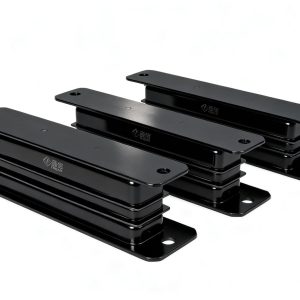
Reviews
There are no reviews yet.