Shear Mode of Rubber Shock Absorbers: Engineering Principles, Advantages, and Industrial Applications B001
1. What Is the Shear Mode of Rubber Shock Absorbers?
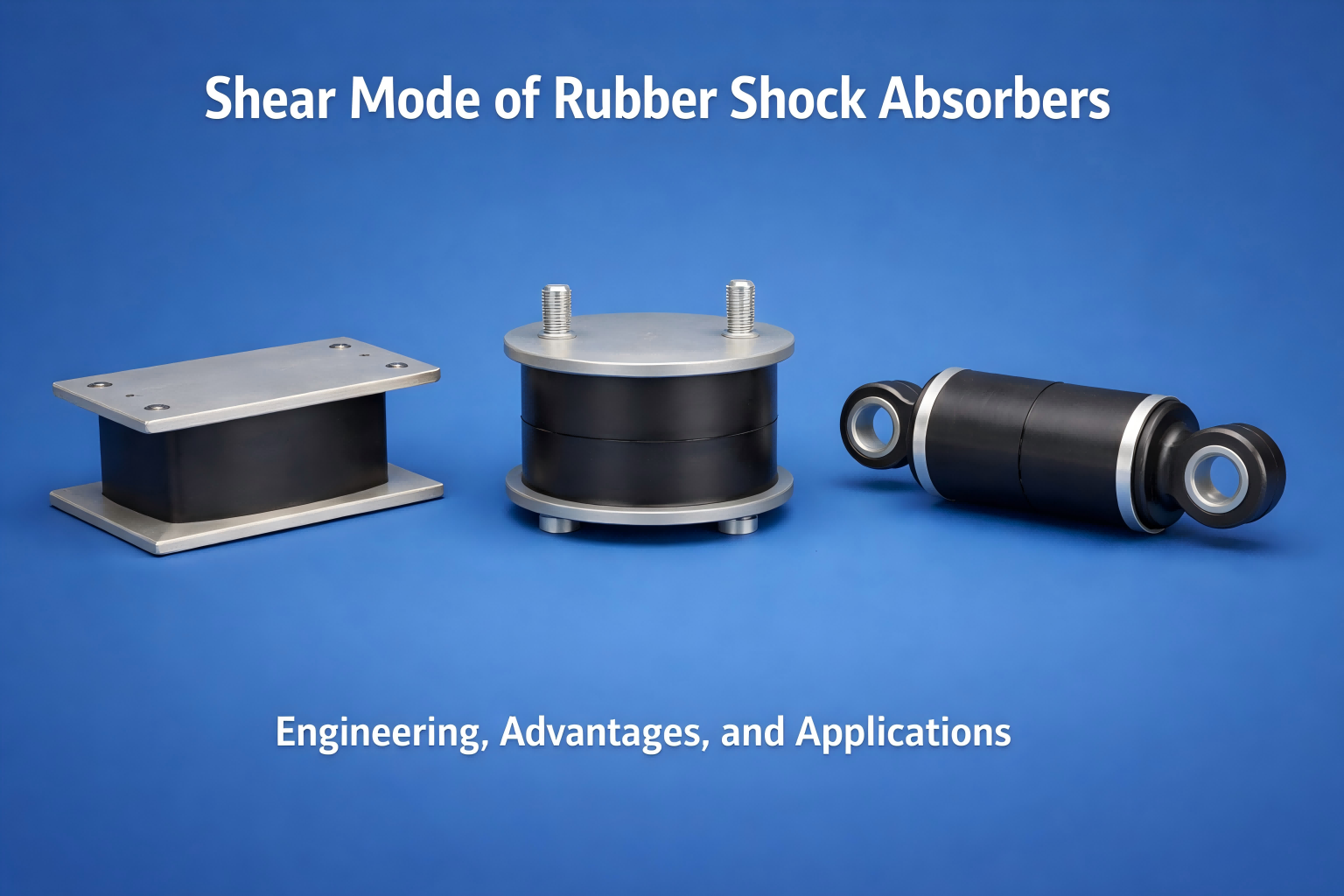
The shear mode of rubber shock absorbers refers to a working condition in which the rubber elastomer primarily experiences tangential loads that act parallel to the bonding interface between rubber and metal components. In this configuration, the rubber layer undergoes interlayer shear deformation rather than compression or tensile deformation.
Mechanically, the direction of the external load remains parallel to the bonded surfaces of the rubber layers. This causes internal tangential displacement within the rubber material, allowing adjacent layers to slide slightly relative to one another. Instead of being compressed vertically, the elastomer absorbs motion through controlled shear distortion. Shear Mode of Rubber Shock Absorbers.
When subjected to cyclic vibrations or impact loads, the inherent viscoelastic properties of rubber allow it to absorb and dissipate vibration energy continuously during the shear deformation process. As a result, shear-mode rubber mounts effectively provide vibration isolation, damping, and buffering performance.
2. Mechanical Characteristics of Shear-Mode Rubber Dampers
One of the defining characteristics of the shear mode of rubber shock absorbers is the difference between shear stiffness and compression stiffness. Rubber typically exhibits much lower stiffness under shear loading, enabling the system to produce larger deformations while maintaining stable mechanical behavior. Shear Mode of Rubber Shock Absorbers.
This property leads to a lower natural frequency of the vibration isolation system, making shear-type dampers especially effective at isolating low- and mid-frequency vibrations commonly found in rotating machinery and industrial equipment.
Additionally, because deformation occurs mainly through distributed shear within the rubber layers, internal stress tends to be more evenly distributed, reducing the risk of localized stress concentration. This improves fatigue resistance and extends service life, particularly in environments with continuous cyclic loading.
3. Key Advantages of the Shear Mode of Rubber Shock Absorbers
The shear mode offers several important performance advantages that make it highly valuable in vibration isolation design.
First, the lower stiffness and lower natural frequency provide excellent vibration isolation capability. Systems using shear-type rubber mounts can significantly reduce vibration transmissibility and effectively suppress resonance peaks.
Second, shear-mode structures allow larger elastic deformation, which improves buffering capacity and enables the mount to absorb shock loads more efficiently. This property is particularly useful for machinery that experiences intermittent impacts or fluctuating dynamic loads.
Another advantage lies in the uniform stress distribution inside the rubber layers. Because the deformation occurs gradually across the entire elastomer structure, the material experiences less stress concentration. This improves the fatigue resistance of the rubber and extends its operational lifespan.
4. Limitations of Shear-Mode Rubber Shock Absorbers
Despite its advantages, the shear mode also presents certain design limitations that must be considered in engineering applications.
One of the primary constraints is the limited axial and radial load capacity. Compared with compression-based rubber mounts, shear-mode structures typically cannot withstand very large static loads on their own. Excessive loads may lead to excessive deformation or structural instability.
Additionally, shear-mode mounts often exhibit relatively low lateral stiffness. In environments involving multi-directional vibrations, overturning moments, or complex impact loads, the system may experience tilting, lateral displacement, or oscillation if not properly constrained.
Another factor to consider is the long-term behavior of rubber materials. Under sustained loads, elevated temperatures, or harsh environmental conditions, rubber may experience creep and stress relaxation, which can gradually shift the initial installation position. Proper design of limit structures, material formulations, and mounting methods is therefore necessary to ensure stable long-term performance.
5. Typical Applications of Shear-Mode Rubber Shock Absorbers
Thanks to their low stiffness, large deformation capability, and excellent fatigue resistance, shear-mode rubber shock absorbers are widely used in applications where vibration isolation and noise reduction are critical.
5. 1. General Industrial Machinery Isolation
Shear-mode dampers are commonly used in vibration isolation systems for fans, pumps, air-conditioning units, compressors, and generator sets. In these applications, they reduce vibration transmission from equipment to building structures or foundations, minimizing structural resonance and noise radiation.
5. 2. Precision Instruments and Laboratory Equipment
Precision measurement devices and laboratory instruments require extremely stable operating conditions. Shear-mode vibration isolators help create low natural-frequency isolation systems that prevent external vibrations from affecting measurement accuracy.
5. 3. Automotive Powertrain Mounting Systems
In automotive engineering, the shear mode of rubber shock absorbers is widely applied in engine mounts, transmission mounts, and electric motor mounts for new energy vehicles. The large deformation capability and effective damping properties help isolate vibrations generated by powertrain operation while also reducing road-induced vibration transmitted to the vehicle body.
5. 4. Rail Transportation and Heavy Equipment
Shear-type rubber mounts are also used in rail vehicle equipment compartments, cab isolation systems, HVAC units, and industrial machinery such as hydraulic equipment and vibrating screens. Under repeated dynamic loads, these mounts provide reliable fatigue resistance and stable vibration isolation performance.
6. Shear-Mode Rubber Isolation Solutions
With continuous advancements in vibration control technology, the shear mode of rubber shock absorbers has become a core design concept in many modern vibration isolation systems.
Ginotek, specializing in rubber–metal bonded components, utilizes advanced vulcanization processes and structural optimization techniques to produce high-performance shear-mode mounts. These products combine low stiffness, large deformation capability, and efficient energy dissipation, allowing them to effectively suppress mid- and low-frequency vibrations while maintaining long-term durability.
Through customized engineering—such as optimizing rubber formulations, adjusting layer configurations, and matching stiffness with load conditions—modern shear-mode isolators can achieve an optimal balance between vibration isolation performance, load-bearing capacity, and installation stability, delivering reliable vibration control solutions for increasingly demanding operating environments.